Alcohol and relationships come apart slowly, not all at once. The damage rarely shows up as one dramatic event. It builds through missed evenings, small broken promises, and one partner quietly becoming the household’s only reliable adult. By the time the drinking gets named as the problem, the relationship has usually already reorganized itself around it.
At Revive Recovery Centers in Mesa, we work with couples and families in exactly this position every week. Below, clinical director explains what heavy drinking does to a partnership over time, where a loved one’s support quietly turns into enabling, and what we do about it.
What Alcohol Does to a Relationship Over Time
The erosion is gradual, which is exactly why it is so easy to miss. Each individual moment looks minor. The pattern underneath is not.
The Warning Signs We See Most
When couples come to us, the same signals show up again and again. If several of these sound familiar, alcohol has likely already become a third presence in the relationship:
- Plans get canceled or forgotten, and the sober partner stops making them
- Arguments start late at night, over nothing, and repeat
- One partner carries the bills, the childcare, and the logistics alone
- Trust has been replaced by monitoring, checking, and bracing for the next incident
- Intimacy and shared plans for the future have quietly disappeared
Why the Damage Compounds
None of this happens in isolation. Research on married couples shows that alcohol use and relationship satisfaction drive each other in both directions: heavy drinking lowers satisfaction, and a distressed relationship fuels more drinking. That loop tightens over time, which is why waiting rarely makes things better on its own.
When It Stops Being Safe
We also have to name the hardest part directly. Alcohol is a well-documented factor in conflict and aggression between partners, and the risk rises as drinking escalates.
If you ever feel unsafe, that is not something to manage inside the relationship. Reach out for help, and in an emergency, call 911.
When One Partner Gets Sober, and the Other Didn’t See a Problem
Recovery can create distance before it closes it, and this catches many couples off guard. Here is what tends to happen and why.
The Gap That Opens
When one partner gets sober and the other never believed the drinking was a real problem, sobriety can widen the space between them. The routines the couple shared, often built around drinking, no longer fit. One person is changing quickly, and the other can feel left behind, or quietly judged.
Why We Treat the Relationship, Not Just the Person
This is why treatment that ignores the relationship tends to fall short. When one person changes and the system around them stays the same, the pull back toward old patterns is strong.
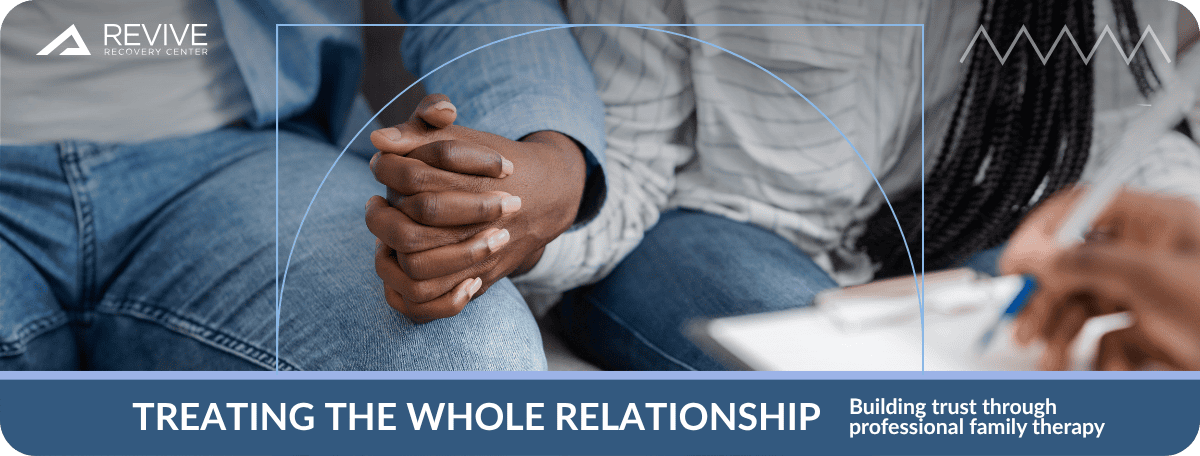
Family therapy is built into our alcohol rehab program for that reason, so the relationship has a chance to change alongside the person rather than snapping back to what it was.
Can a Relationship Survive One Partner’s Alcohol Use Disorder?
Often, yes, but survival is neither automatic nor passive. In our experience, the relationships that make it through tend to share three things:
| What helps a relationship survive | What keeps it stuck |
| Treating drinking as a health condition | Treating it as a moral failing to argue about |
| The sober partner getting their own support | The sober partner absorbing everything alone |
| Rebuilding trust gradually, through action | Demanding trust be restored all at once |
What does not work is expecting the relationship by itself to fix the drinking. Alcohol use disorder is a clinical condition, and love, patience, and ultimatums no more treat it than they would treat diabetes.
The relationship can be a powerful reason to seek help. It cannot be the treatment.
The Line Between Supporting and Enabling
This is where our clinical experience matters more than any general advice, and it is the question families ask us most.
The Soft Pillow
“Families can, and often do, soften the blow in any number of ways,” Lee says. “They may make excuses, or provide financial resources, or, as an expression that I use, they provide a soft pillow at night for somebody to bed down for the night.”
Those actions look like love. In most cases, they are also what allows the drinking to continue without consequence.
Where We Draw the Line
We coach families to draw the boundary around what the help actually funds. As Lee puts it: “If I want to support my loved one, perhaps I can support them by underwriting treatment. But supporting them by paying their car insurance or their rent would be a line.”
The principle is simple, even when it is hard to live out: support recovery, not the conditions that make continued drinking comfortable.
It Is a Family Condition
We also want families to hear this clearly, because it lifts a burden rather than adding one. “It is a family systems disease,” Lee says. “Even though we have an identified patient, the family themselves also play significant roles in the disease process, in that enabling role.” That is not blame. It is the reason involving the family changes outcomes.
What We Tell Families Who Keep Covering
If you have been covering for someone you love, the most useful thing you can do may surprise you.
Get Your Own Support First
When families ask what they can do, our answer is consistent: get help for yourself. Connect with a support group, see an outpatient therapist, use the resources in your own community.
“Just that alone,” Lee says, “will promote a whole different way of relating to the addicted loved one.”
A partner with their own support stops relating out of fear and exhaustion, and that shift often does more than any confrontation. Groups like Al-Anon exist for exactly this.
When to Focus on Yourself
There is also a point where your energy is better spent on yourself than on getting the person into treatment. “By getting help for themselves,” Lee says, “they will interact with their loved one in an entirely different way, and in a way that is likely to promote healing and recovery in that person.”
Stepping back is not giving up. Sometimes it is the thing that finally shifts the dynamic.
Do Ultimatums Ever Work?
Rarely, at least not the way people hope. An ultimatum thrown out in anger, with no support behind it and no intention of following through, teaches the drinker that the threat is empty.
A boundary is different, and it does work. A boundary is a clear, calm statement of what you will and will not do, backed by action rather than volume.
The distinction matters because a boundary is about your own behavior, which you control, not a demand for theirs, which you do not. As Lee frames it, the goal is to “support them in the pursuit of their recovery, rather than an action or behavior that would promote ongoing substance use.”
How We Help at Revive Recovery Centers
Most people picture rehab as disappearing for a month. For someone whose relationship and job are still intact, we rarely recommend that. We built our programs so treatment fits around a real life.
Care Built Around Your Schedule
Our Intensive Outpatient Program meets several days a week with morning and evening options, and for those who need more structure, our Partial Hospitalization Program offers full-day support.
If getting to Mesa in person is the barrier, our Virtual IOP runs on the same clinical model from home. When drinking has reached the point where stopping is medically risky, we coordinate supervised detox first.
What Makes Our Care Different
Affordable rehab in Mesa, Arizona does not have to mean lower quality, and this is where we prove it.
Where most outpatient programs in Mesa offer one individual therapy session per week, we provide two at every level of care, plus on-site psychiatry, a dedicated care coordinator, and a full family program. That combination is what lets us treat the relationship and the person at the same time.
Affordable Care in Mesa, Without the Compromise
Cost is one of the most common reasons couples delay, so we address it head-on. Revive was built as affordable rehab in Mesa, Arizona, in a specific sense: clinical-grade outpatient care without the price of a residential stay, not a watered-down version of it.
We verify your insurance benefits at no cost before your first appointment and work with most major commercial and employer plans.
We do not accept Medicaid or AHCCCS.
If alcohol has become the third party in your relationship, the first step is a conversation, not a commitment. Call (866) 311-7152
Ask a Clinician: Alcohol and Families
What is the most common mistake family members make when trying to help?
Providing cash money to that individual is likely an enabling behavior. The line I would draw is to promote awareness within the family of the ways they agree they’re enabling the disease to continue. Draw the line at financial support that doesn’t promote a significant boundary.
Is alcohol addiction really a family problem, or just the drinker’s problem?
It is a family systems disease. Even though we have an identified patient, the family themselves also play significant roles in the disease process, in that enabling role.
What should a partner do if getting the person into treatment isn’t working?
By getting help for themselves, they will interact with their loved one in an entirely different way, and in a way that is likely to promote healing and recovery in that person. Go get help. Connect with a community-based support group. Access the resources in your community.
Where does support end and enabling begin?
If I want to support my loved one, I can support them by underwriting treatment. But supporting them by paying their car insurance or their rent would be a line. Support them in the pursuit of their recovery, rather than an action that would promote ongoing substance use.
Frequently Asked Questions
How does alcohol affect a relationship over time?
It erodes trust, intimacy, and shared responsibility gradually rather than all at once. Drinking and relationship distress reinforce each other, so the pattern tends to deepen over months and years until the relationship reorganizes itself around the drinking.
Can a relationship survive one partner’s alcohol use disorder?
Often, yes, but not passively. Recovery is far more likely when the drinking is treated as a health condition, the sober partner has their own support, and both people rebuild trust gradually. The relationship can motivate treatment, but it cannot replace it.
What is the difference between supporting my partner and enabling them?
Support funds recovery; enabling funds the conditions that let the drinking continue comfortably. Paying for treatment is support. Covering the costs and consequences that would otherwise create pressure to change is usually enabling.
Do ultimatums work for getting someone to stop drinking?
Rarely. An empty threat teaches the drinker it can be ignored. A boundary, a clear statement of what you will and will not do backed by follow-through, works better because it is about your own actions rather than a demand for theirs.
Should I go to therapy if my partner is the one drinking?
Yes. Support for partners and families changes how you relate to the person drinking and protects your own health. It is one of the most effective things a loved one can do, and it often shifts the dynamic in a way that makes treatment more likely.